
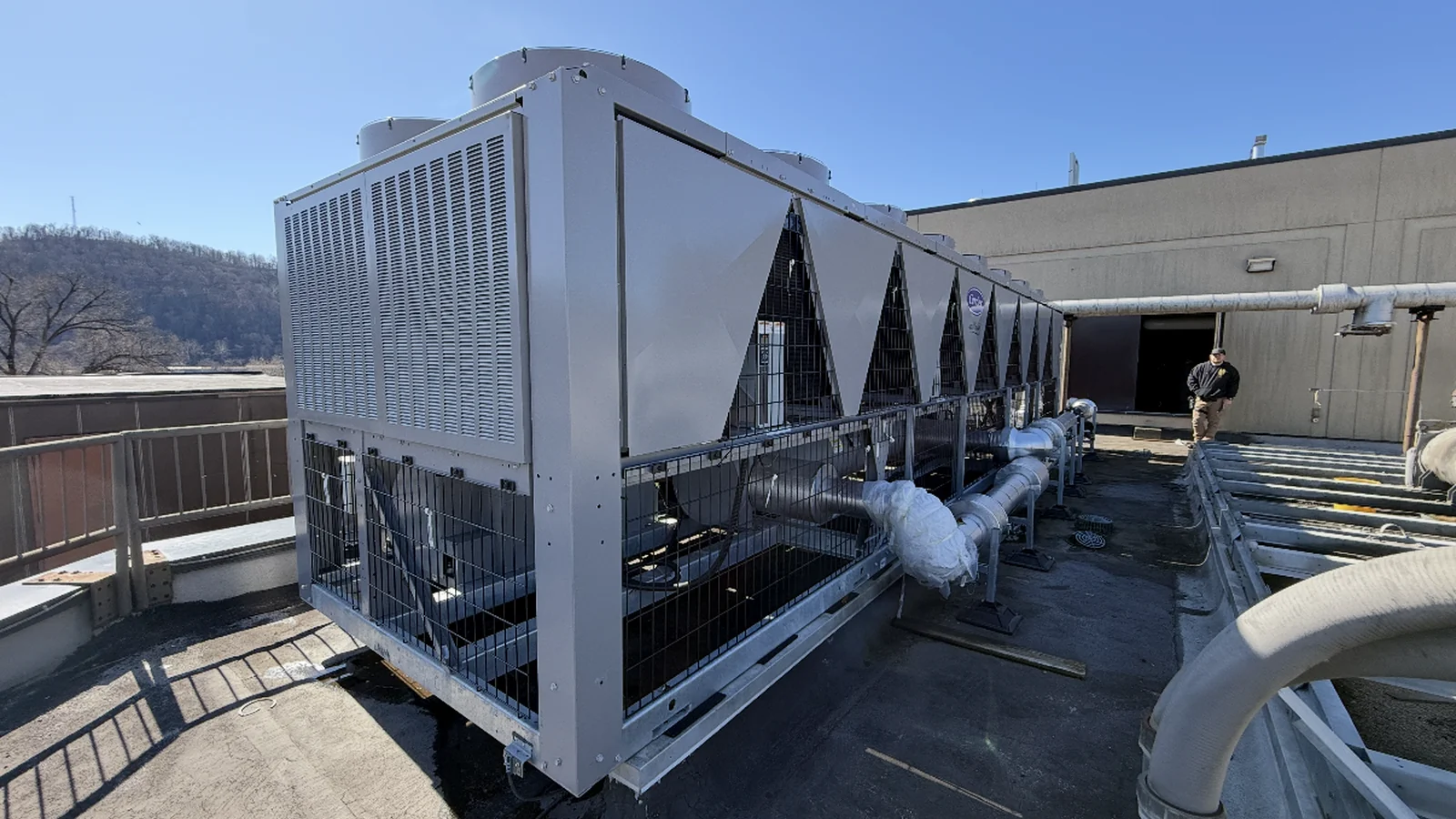
Independent Multistack equipment identification
Multistack Chiller Identification and Sale Preparation
Have a Multistack chiller system to evaluate? First document the full modular array—not just a total tonnage claim—then submit each module’s identity, included accessories, condition, site facts, and release plan to a direct prospective buyer.
Multistack modular-array inquiry
Send the module-and-boundary ledger for buyer evaluation
Send the available facts so a direct prospective buyer can evaluate the exact Multistack equipment and the proposed handoff. This inquiry does not promise a purchase, offer, price, payment, pickup, removal, freight, rigging, dismantling, demolition, refrigerant handling, timing, site visit, local office, or project service. Identify unknowns instead of guessing. Any purchase or work responsibility must be separately agreed in writing.
Useful facts to have ready
- A readable nameplate photograph for every module and separately tagged accessory, recording the exact manufacturer name, model, serial number, electrical data, refrigerant where marked, and manufacture or date information where available.
- A module-and-boundary ledger that identifies the physical location and quantity of modules, array controller or master controller when present, headers, pumps, tanks, strainers, separators, glycol equipment, remote condensers or field evaporators, and each included/excluded item.
- Wide photographs of the complete array and each module, plus control panels, compressor or fan areas, heat exchangers, refrigerant labels, piping connections, damage, missing items, and loose accessories.
- The present status of each module and accessory: operating, idle, isolated, drained, disconnected, stored, incomplete, non-operational, or unknown; include the last known operating date and known alarms, faults, leaks, repairs, or removed parts.
- Exact U.S. location, placement of every module or skid, verified or pending individual and assembled dimensions/weights, route and loading facts, site restrictions, and whether the system remains connected to an active building load.
- Sale authority, ownership or approval issues, realistic release date, and any requested disconnection, removal, refrigerant, rigging, freight, demolition, or other work stated as open—not assumed.
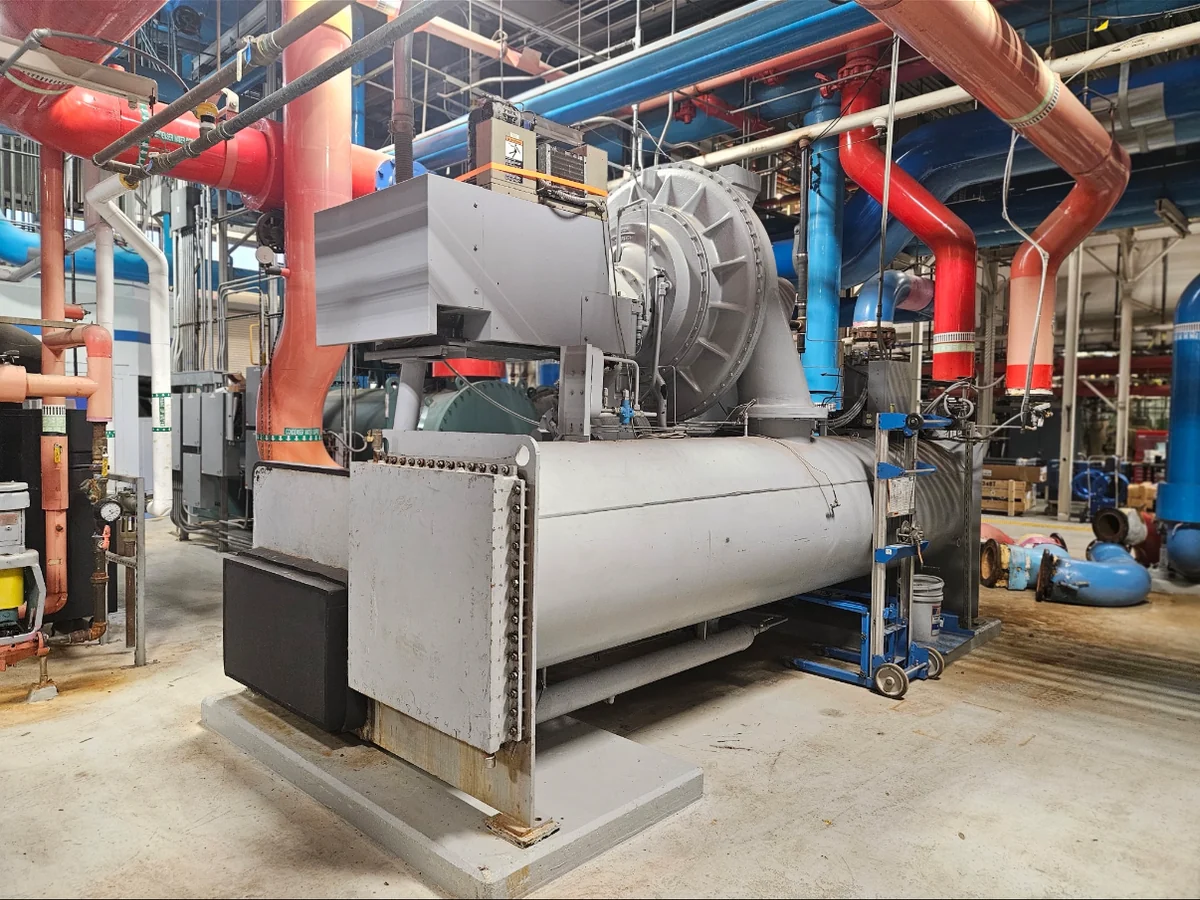
Array evidence before total tonnage
A Multistack installation may be a system of identifiable modules, not one single chiller asset.
Multistack’s modular concept allows capacity to be added module by module and may include factory-packaged accessory modules. Because arrays can combine separate modules and accessory skids, a total-capacity statement alone does not identify which serial-numbered assets are offered or what components remain with the building.
Prepare a module-and-boundary ledger that ties each physical module position to a nameplate photograph, and list headers, valves, controls, pumps, tanks, and accessory skids separately. The ledger is seller documentation to clarify included and excluded items; it is not an engineering drawing, lift plan, or instruction to disconnect equipment.
- Photograph every module nameplate straight on, and take a wide photo showing the module’s position in the full array.
- Record the number of modules present, the number offered, and exact serial numbers for included, excluded, missing, or unknown modules.
- Identify the master controller, array controller, standalone control enclosure, and visible communication wiring only if present; do not assume a controller governs every module.
- List pumps, tanks, strainers, air separators, glycol feeders, expansion tanks, chemical pot feeders, headers, and skids as separate assets or boundary items.
- Identify the visible supply/return header boundary and state whether building piping, remote condensers, field evaporators, or electrical gear remain with the site.
Configuration-led identification
Confirm whether the offered module is air-cooled, water-cooled, split, a condensing unit, free-cooling equipment, or a heating/heat-recovery product.
Multistack product materials distinguish multiple equipment functions and model families; current catalogs list water-cooled scroll, water-cooled MagLev, air-cooled scroll, air-cooled free-cooling, condensing units, split systems, and dedicated heating/heat-recovery products. Use those family names only as evidence prompts and do not convert a family name into a specification for a particular serial-numbered module.
Preserve the exact nameplate model, serial number, electrical rating, and attached-component identifiers. If a record is ambiguous about whether a module is a packaged chiller, a condensing unit, or a split module, report the uncertainty rather than relabeling the asset as a complete chiller.
Present condition over performance promises
A modular system can have uneven condition, changes, or missing parts from one module to the next.
Because Multistack arrays can contain multiple refrigerant circuits, different control arrangements, and separately serviced modules, a plant-wide statement such as “the Multistack is working” is not adequate for a module-level evaluation. Tie observed facts and records to the serial-numbered module they concern and avoid broad performance claims.
For every offered module, state the module’s current status and the source and date of the last known operation. Describe visible damage, corrosion, leakage evidence, coil condition, fan or compressor area condition, disconnected lines, removed controls, and storage exposure without claiming the equipment is operational or tested.
Machine scope and site scope
Describe the handoff requirements without assuming Surplus Chiller Buyer performs project work.
Define machine scope and site scope separately. Machine scope identifies the exact modules, accessories, headers, panels, pads, and loose components offered; site scope identifies what is connected to the building and may require isolation or authorization, such as electrical feeders, controls, chilled‑water piping, condenser‑water piping, remote condensers, and active loads.
This page does not offer removal, rigging, dismantling, refrigerant work, or site services. Where disposal involves chillers dismantled on site before disposal, EPA guidance states refrigerant must be recovered under applicable servicing requirements before disposal, and that technicians performing covered work must hold appropriate certification.
Direct prospective buyer review
An accurate array record gives a buyer facts to evaluate, not a promise to purchase or perform site work.
Combine the module-and-boundary ledger, nameplate evidence, configuration record, condition record, included/excluded list, site facts, sale authority, and release timing into a single dossier so a direct prospective buyer can evaluate the exact offered assets. An organized dossier prevents an entire array, a single module, accessories, and facility-side equipment from being conflated.
A submission, follow-up question, site discussion, or review does not create a purchase agreement or guarantee purchase, offer, price, payment, pickup, removal, freight, rigging, dismantling, demolition, refrigerant handling, timing, inspection, local presence, or project service. Any agreed responsibilities must be documented in writing and tied to serial-numbered equipment.
Frequently asked questions
Before you send the chiller.
If your machine does not fit a standard category, submit the available details anyway. Clear photographs and a readable nameplate often establish whether more information is worthwhile.
Should I submit one nameplate for the whole Multistack array?
No. Submit a readable nameplate for every offered module and for separately identified accessories where available. Multistack’s modular design permits arrays of multiple modules, and official material describes accessory modules and array-level controls. A total plant capacity or one controller label does not identify every serial-numbered asset.
Is every Multistack-branded unit a complete water-cooled chiller?
No. Multistack’s current materials cover air-cooled and water-cooled modular equipment, split systems, condensing units, free-cooling equipment, heat-recovery equipment, and heat pumps. In particular, current catalog descriptions identify ADX and MSD as condensing units intended to connect to a field-supplied evaporator. Identify the actual unit and connected equipment rather than calling every brand-labeled module a complete chiller.
Can I submit only some modules from a larger Multistack installation?
Yes. Clearly mark the serial-numbered modules that are offered and those that are excluded, missing, active, or subject to approval. Include the header, control, accessory, and building-system boundaries so a buyer can understand whether the offered units are an intact array, a partial array, or separate modules. Submission does not guarantee a purchase or any project service.
Does a current Multistack model name prove the offered equipment’s capacity, refrigerant, or compressor type?
No. Current catalog names such as MSS, ASF, ASP, MSA, or MSH DHRC are helpful evidence prompts only. The exact model, serial number, capacity, refrigerant, compressor, options, and condition must be supported by the actual equipment and matching records. Do not infer specifications from a family name or stock image.
Will Surplus Chiller Buyer disconnect, rig, remove, freight, dismantle, or recover refrigerant from my Multistack equipment?
No responsibility is included automatically. Provide the machine and site boundaries, access facts, release date, and open project needs for evaluation. Any accepted responsibility must be confirmed in writing. Where disposal involves chiller equipment dismantled on site, EPA says refrigerant must be recovered under applicable servicing requirements before disposal, and certified technicians are required for covered work that could release refrigerant.
Authoritative references
Source material behind this seller guide.
These external manufacturer and government sources support the equipment terminology and planning context used above. They do not establish the condition, configuration, safety, compliance, or transaction fit of a specific chiller.