
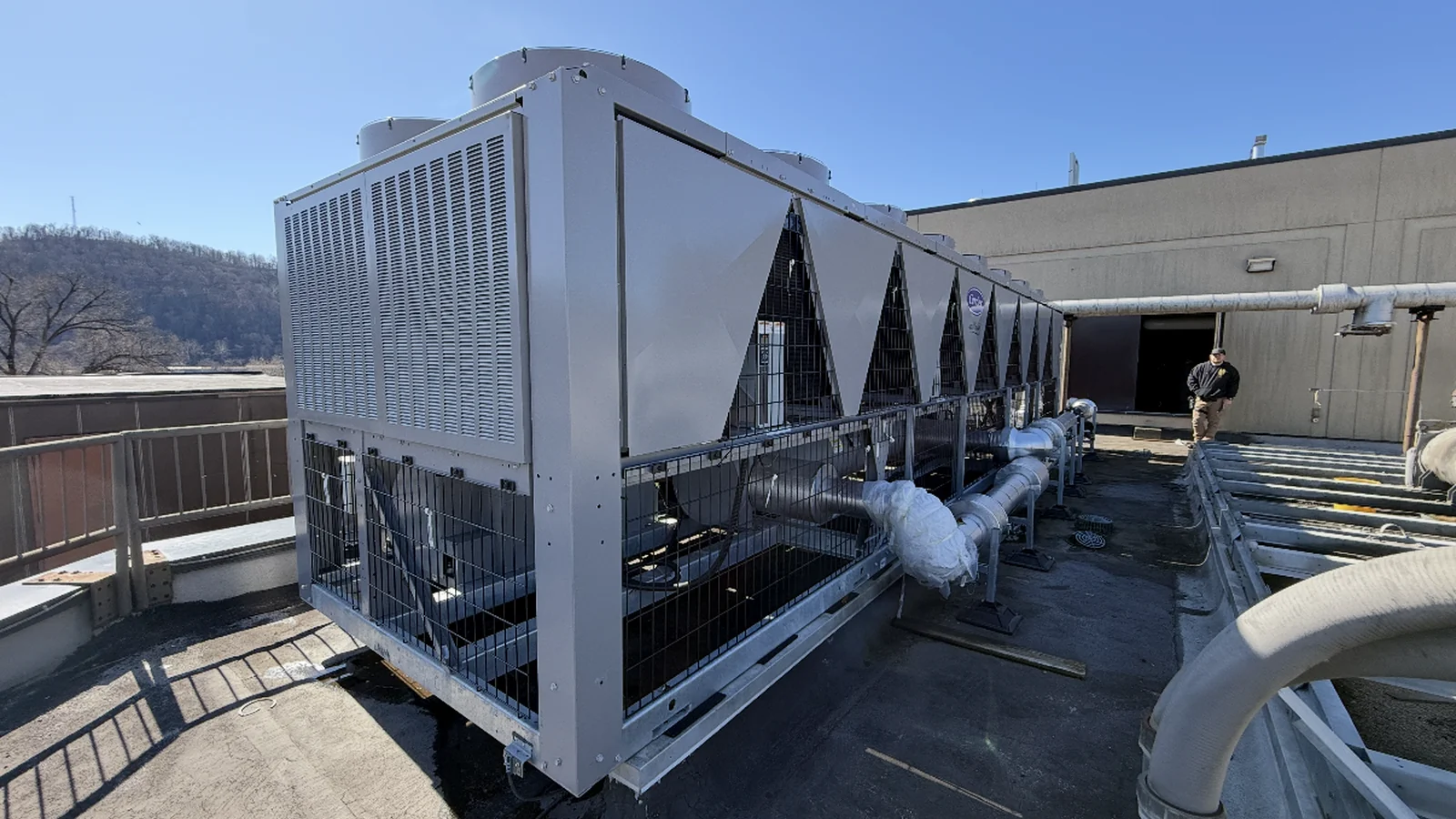
Independent AquaSnap equipment guide
AquaSnap Chiller Buyers: Map the Modules Before You Submit
To sell a used AquaSnap chiller, start with the exact machine record and a map of what is connected to it. AquaSnap is a Carrier product line, not a separate manufacturer. Surplus Chiller Buyer is an independent prospective buyer and is not affiliated with Carrier, AquaSnap, or their owners; the AquaSnap name is used here only to identify equipment submitted for evaluation.
Send the module map, not just the brand name
Start with the AquaSnap nameplate and what stays with each module.
Unique seller task: Build an AquaSnap module-and-boundary map. Place the existing native request form directly below the hero. Ask the seller to provide every readable model and serial number, a photograph of each nameplate, and a short module-and-boundary map. The map should explain whether the offered equipment is one air-cooled package, one indoor module, or a group of modules; what controls, hydronic components, manifolds, pumps, tanks, electrical equipment, and loose parts are included; and what remains with the facility. Carrier’s current documentation shows that AquaSnap may refer to materially different arrangements, including 30RC air-cooled scroll equipment and 30MP indoor packaged or condenserless configurations. The form begins a buyer evaluation only. It does not guarantee purchase, an offer, price, payment, pickup, removal, freight, rigging, dismantling, demolition, refrigerant handling, timing, a local office, or any project service. Whether there is interest, a transaction, or any separately agreed work scope depends on the actual equipment and site facts and must be confirmed in writing.
Useful facts to have ready
- A straight-on, readable photo of every AquaSnap nameplate, with model and serial number typed exactly as shown for each module or package.
- Wide photos of each complete unit, including fan/coil sides where present, compressor compartments if safely visible, evaporator/condenser connections, controls, and any removed panels or parts.
- A module map that labels each unit by photo, model/serial, present status, and whether it is offered, retained, missing, or unknown.
- The refrigerant and electrical information shown on each relevant label, plus nominal capacity only when supported by the unit tag or records; do not infer this from the AquaSnap name alone.
- A boundary list for included and excluded pumps, hydronic packages, manifolds, storage tanks, controls, starters, communication hardware, loose spares, and connected plant equipment.
- The current location and installation status, owner/authorized-contact status, access and release constraints, and the proposed release date if terms are agreed.
01 / Identify the unit, not the label alone
Treat “AquaSnap” as a product-family clue, then prove the exact machine.
Carrier’s current U.S. materials identify AquaSnap as a product line with more than one arrangement. The current 30RC page identifies an air-cooled scroll chiller; the current 30MP page identifies indoor water-cooled and condenserless liquid-chiller or heat-pump configurations. A seller should therefore submit the exact model and serial number on the installed or stored equipment, rather than treating “AquaSnap” as a complete description.
Start each record with a full nameplate photograph and a typed transcription. Where there are several units, assign a simple identifier such as “Module A” and “Module B,” then repeat it consistently on photos and records. A 30RAP label is not interchangeable with a 30RC or 30MP label: Carrier’s official 30RAP technical page identifies it as an air-cooled scroll line using R-410A, whereas current 30RC and 30MP materials identify R-32 for those listed lines. Do not guess the refrigerant or configuration when the tag is missing or unreadable. Surplus Chiller Buyer is independent and is not affiliated with Carrier, AquaSnap, or their owners.
- Photograph the complete nameplate for every offered 30RC, 30RAP, 30MP, or other AquaSnap-labeled unit; record all characters, dashes, and suffixes exactly.
- Label each wide unit photo with the matching module identifier, so the buyer can connect the nameplate to the physical equipment.
- State whether the unit appears air-cooled outdoors or an indoor water-cooled/condenserless arrangement, then support the statement with photos and records or mark it unknown.
- If the nameplate names R-32, R-410A, or another refrigerant, transcribe it exactly; do not substitute a refrigerant based on a current Carrier page.
02 / Show the actual package
A group of AquaSnap modules is not automatically one sale package.
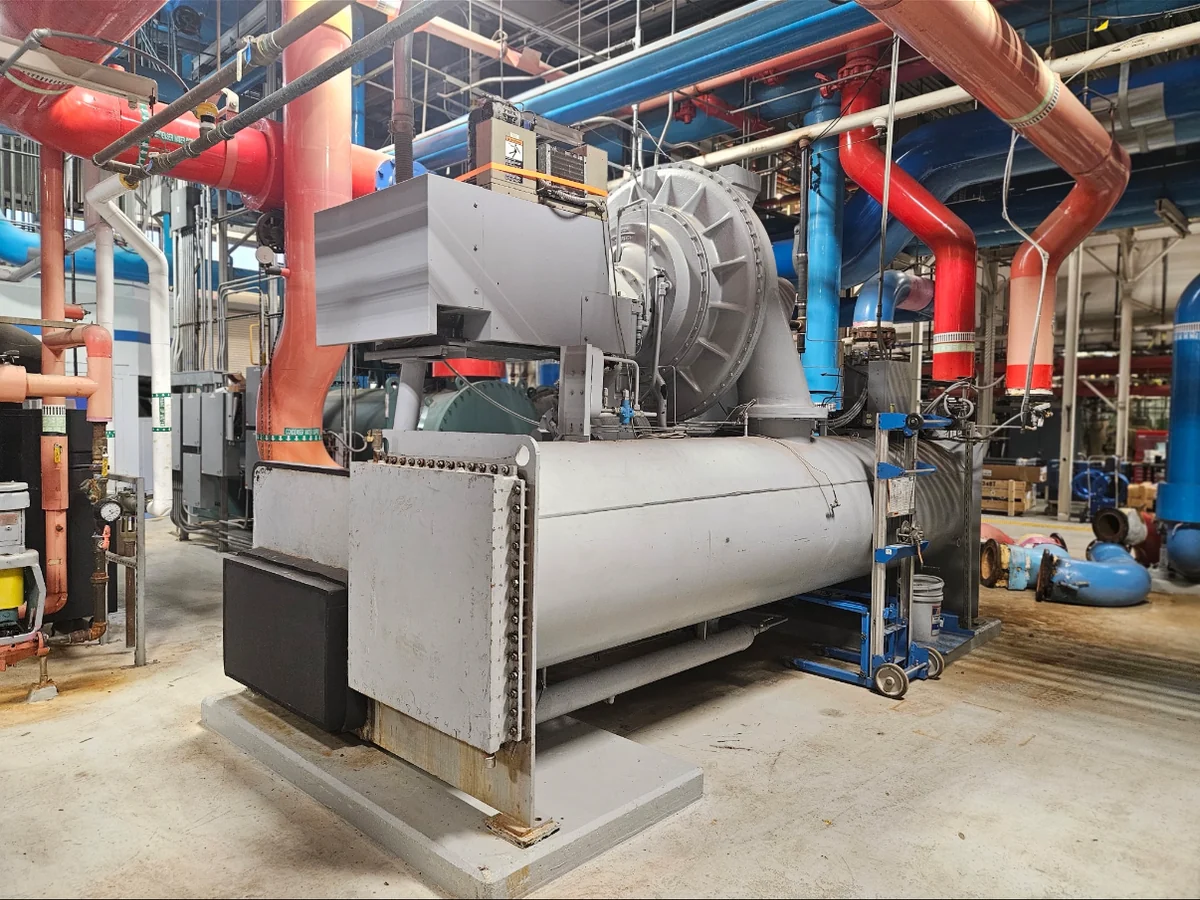
Build an AquaSnap module-and-boundary map. AquaSnap documentation makes modularity a material identification issue. Carrier describes the current 30MP series as compact modular equipment and lists condenserless, packaged, and water-to-water heat-pump models. A seller with multiple indoor modules should map the physical arrangement instead of calling the entire mechanical room “one chiller.” For each module, identify its module label, model/serial record, operational status, controller display or communication hardware, and visible water-side or refrigerant-side connections.
The equipment boundary is equally important. A manifold, hydronic pump package, buffer tank, electrical distribution panel, plant controls, cooling tower, condenser-water piping, valves, or building-management hardware may be near a chiller but may be retained, shared, leased, missing, or controlled by another party. Put each item in an included, excluded, retained, missing, or unknown column. That scope map lets a prospective buyer review the stated asset without assuming a larger chilled-water plant transfers with it.
03 / Keep records tied to the offered machine
Distinguish current product documentation from the condition of the used equipment in front of you.
Carrier’s current product pages can help a seller use the correct terms, but they do not verify an installed unit. Carrier presently lists the 30RC as an air-cooled scroll chiller with R-32, and its current 30MP page lists R-32 for indoor 30MP configurations. Carrier’s 30RAP technical page lists R-410A for that air-cooled scroll line. These differences are a reason to collect exact tag information and maintenance records, not a reason to describe an offered unit as updated, compliant, charged, functional, or suitable for a particular refrigerant.
Keep an evidence record separate from operating claims. State the refrigerant only as shown on the nameplate or supported records. State the last known operating date, alarms, repairs, leaks, disconnected lines, removed components, storage conditions, or unknown items in direct language. If the equipment might be dismantled or disposed of rather than transferred intact, EPA states that chillers and other equipment typically dismantled on site must have refrigerant recovered under Section 608 servicing requirements before disposal. This is a planning and compliance point, not an offer by Surplus Chiller Buyer to recover refrigerant.
04 / Capture the visible proof by module
Show controls, hydronics, and condition in a way that matches the module map.
The evidence set should show the full equipment and the features that establish configuration. For an air-cooled AquaSnap package, photograph every exterior side, the fan and coil areas, the controls, the base, and visible water connections. For an indoor 30MP-style arrangement, photograph each module, its controls, the module-to-module relationship, visible manifold or piping connections, and any accessory that the seller proposes to include. Carrier’s current 30MP materials specifically describe packaged and condenserless options; photographs should therefore not label a unit as water-cooled merely because it sits near water piping.
Photographs document what is observable; they do not guarantee operating condition, completeness, capacity, serviceability, or buyer interest. Show known damage, corrosion, coil condition, leaks or stains, missing panels, altered wiring, disconnected piping, and stored loose parts openly. If access prevents a safe photo, say what could not be documented and why. The prospective buyer can then request clarification without anyone treating a general brand reference as a warranty.
05 / Keep release planning conditional
Define the site facts and open work boundaries before relying on any transaction.
An AquaSnap submission can be reviewable even when the release plan is unfinished. State whether each offered module is installed, disconnected, stored, operating, non-operational, or unknown; where it is located; what access exists; what parts of the plant must remain; and when the seller could release the listed equipment if terms are agreed. A submission, follow-up question, or site discussion does not assign pickup, removal, freight, rigging, dismantling, demolition, refrigerant handling, timing, or another project service to Surplus Chiller Buyer.
If site work becomes part of a separately negotiated transaction, describe the scope precisely rather than using a general word such as “removal.” Intact removal means taking the identified machine or modules out as units; it is different from dismantling or cut-up/demolition. Before any qualified-party planning, verify the exact included modules, weights and dimensions from the applicable unit data, lifting points, travel route, opening and staging constraints, site controls, and disconnection boundaries. Refrigerant recovery is a conditional compliance item for a dismantled-on-site chiller under EPA Section 608 guidance; hazardous materials review, permits, utility isolation, structural review, site restoration, and any rigging plan depend on the actual site and responsible qualified parties. None of this work is automatically included or promised by this page.
Frequently asked questions
Before you send the chiller.
If your machine does not fit a standard category, submit the available details anyway. Clear photographs and a readable nameplate often establish whether more information is worthwhile.
Is AquaSnap a separate chiller manufacturer?
No. Carrier’s current product pages present AquaSnap as a Carrier product line, including 30RC and 30MP equipment. Surplus Chiller Buyer is independent and is not affiliated with Carrier, AquaSnap, or their owners. “AquaSnap” is used only to identify equipment that a seller may submit for evaluation.
I have several AquaSnap units connected together. Should I submit them as one chiller?
Submit a module-and-boundary map. Give each physical module its own nameplate photo, model/serial transcription, current status, and photo identifier. Then list the common controls, manifolds, pumps, tanks, electrical equipment, and connected plant components as included, excluded, retained, shared, missing, or unknown. A connected group is not automatically one sale package.
My nameplate says 30RAP, 30RC, or 30MP. Can I use the current product page to fill in missing information?
No. Use the page only as a terminology reference. Carrier’s current pages differentiate 30RC and 30MP configurations from its 30RAP technical information, including the listed refrigerant. Type only the exact facts visible on the offered unit or supported by its records, and mark missing information as unknown.
Do I need to provide refrigerant information for a used AquaSnap chiller?
Provide the refrigerant shown on the equipment label or reliable records, and identify any conflict rather than choosing one. Do not assume it from the AquaSnap brand. If the equipment is expected to be dismantled on site for disposal, EPA says chillers must have refrigerant recovered under Section 608 servicing requirements before disposal. This page does not promise or arrange that work.
Does the evaluation form include removal, rigging, dismantling, demolition, freight, or refrigerant handling?
No. The form starts an evaluation of the identified equipment and site facts. It does not guarantee a purchase, offer, price, payment, pickup, removal, freight, rigging, dismantling, demolition, refrigerant handling, timing, a local office, or any project service. Any potential transaction and any agreed responsibility must be set out in writing for the actual equipment and project.
Authoritative references
Source material behind this seller guide.
These external manufacturer and government sources support the equipment terminology and planning context used above. They do not establish the condition, configuration, safety, compliance, or transaction fit of a specific chiller.