
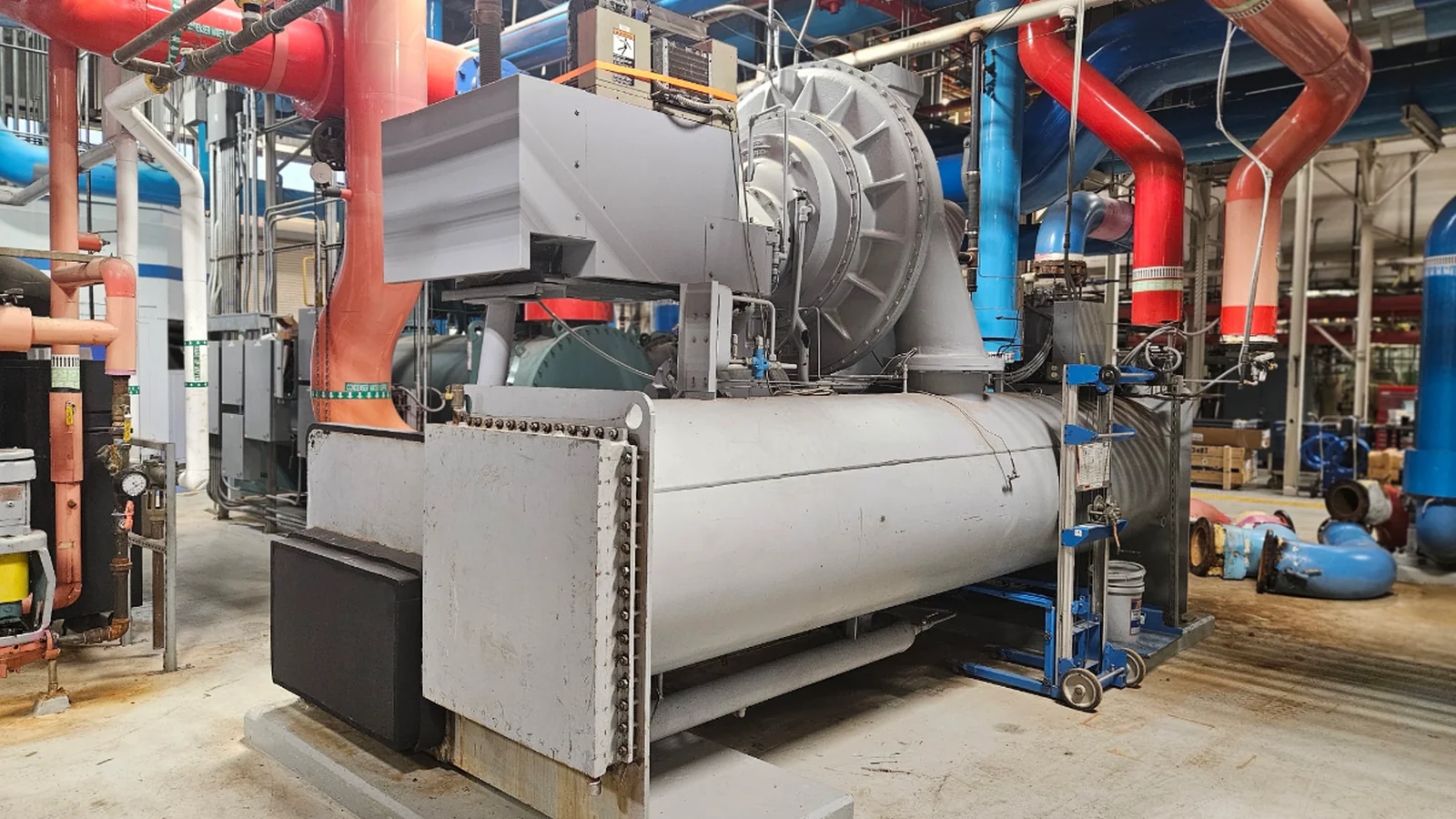
Independent Thermax equipment-identification guide
Thermax Absorption Chiller Identification and Sale Preparation
A Thermax absorption chiller can be tied to steam, hot water, fuel, exhaust, thermic fluid, or more than one thermal source. Before you submit a U.S. unit for direct buyer evaluation, document the exact machine and make a short map of the thermal source and water-side connections that affect its release. Submission does not guarantee purchase, an offer, price, payment, pickup, removal, freight, rigging, dismantling, demolition, refrigerant handling, timing, or a local office.
Direct buyer inquiry for a Thermax absorption chiller
Send the chiller record and its thermal-source map
Surplus Chiller Buyer is an independent prospective buyer of used and surplus industrial chillers. It is not Thermax Limited, a Thermax dealer, distributor, service provider, or authorized representative. “Thermax” is used on this page only to help a seller identify equipment. This site does not sell Thermax equipment or represent current manufacturer support, parts availability, performance, safety, or value. Share only information you are authorized to provide. Start with a readable nameplate and photographs, then explain what supplies heat to the unit and what plant equipment remains connected. This is a request for buyer evaluation, not a purchase agreement or a commitment by Surplus Chiller Buyer to inspect, buy, quote, pay for, disconnect, recover refrigerant from, rig, dismantle, demolish, remove, load, transport, or restore anything.
Useful facts to have ready
- A straight-on, readable photograph of every nameplate, tag, model code, and serial number, plus wide images of the full chiller and controls.
- The apparent Thermax configuration: steam-, hot-water-, direct-fired, exhaust-, thermic-fluid-, or multi-energy-driven, if supported by the nameplate, manual, or installation records; otherwise state “not confirmed.”
- A thermal-source dependency map showing each inlet and outlet, the associated plant system, whether it is live or isolated, and what must remain in service.
- Photographs and a list of included versus excluded equipment, including control panel, pumps, burner/fuel-train components, heat-recovery ducting, valves, skids, and loose accessories.
- Current condition, last known operating date, known alarms, leaks, corrosion, tube work, repairs, missing parts, shutdown reason, and available service or water-treatment records.
- Exact U.S. location, installed status, floor or roof position, dimensions and verified weight if available, exit route, site rules, release window, and the person authorized to discuss a sale.
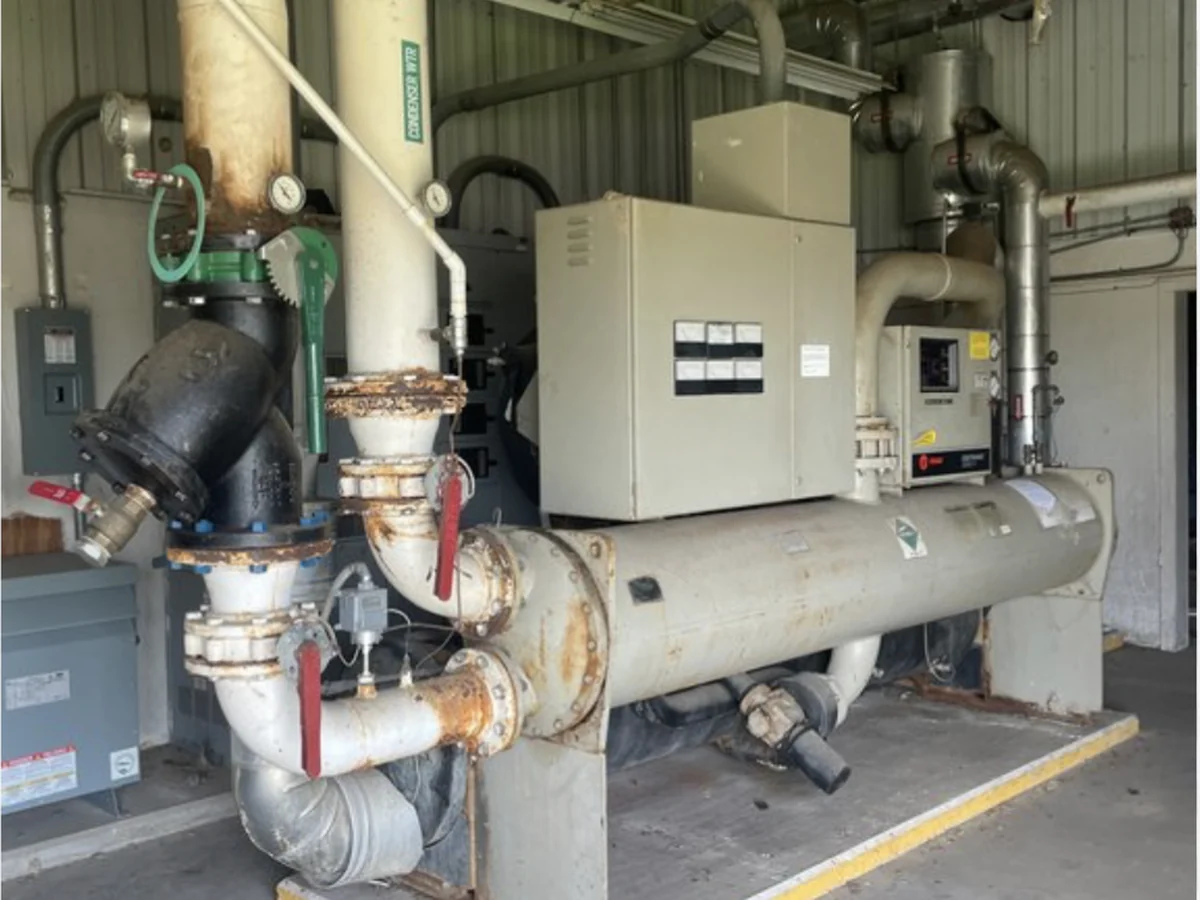
Equipment identity first
Read the nameplate, then verify the heat-source configuration.
Thermax is an equipment-identification clue, not a complete equipment description. Thermax’s official current range includes absorption chillers driven by steam, hot water, direct firing, exhaust, multiple energy sources, and thermic fluid. A seller should not call a unit steam-driven, direct-fired, or heat-recovery equipment from a distant photograph or an old facility schedule alone. Use the nameplate, model documentation, piping labels, and available records to identify what is actually offered.
For historical records, do not treat every old document as a different manufacturer without checking the serial-numbered machine. Thermax’s corporate history says its predecessor was Wanson (India) and that the company was renamed Thermax in 1980; the current company identifies itself as Thermax Limited. Record the exact name shown on the unit and attach older records as evidence rather than relabeling the asset based on memory.
- Photograph the machine nameplate, controls nameplate, pressure/vessel tags, and all serial-number labels before cleaning or moving anything.
- Transcribe model code, serial number, manufacture year if shown, capacity in TR, electrical data, and the source of each field.
- If the records show an S1, S2, S3, S5, H1, H2, L1, L5, or LH designation, photograph the supporting record and state that the code has or has not been confirmed on the machine; do not guess a code.
- Keep “Thermax,” “Thermax India,” and “Wanson (India)” records tied to the actual unit number that they support.
- List each chiller separately if a central plant contains multiple units, even if they share a control room or thermal source.
The seller task unique to this brand
Show what gives the absorption chiller its heat—and what must stay behind.
An absorption chiller is not identified by electrical data alone. The thermal input can shape the release plan. Thermax publishes current steam-driven single-, double-, triple-effect, ultra-low-pressure, low-temperature, and sub-zero variants, and it publishes hot-water-driven variants across temperature ranges. Those product families make source type, pressure or temperature information, and actual connections meaningful evidence, but they do not prove the configuration of a particular used machine.
Draw a simple site-specific map from the chiller to the connected systems. Label thermal source supply and return, chilled-water supply and return, cooling-water path, condensate or drain points, exhaust or heat-recovery ducting when present, fuel or electrical interfaces, controls, and any shared pumps or cooling-tower components. Mark every line as active, isolated, removed, unknown, or required to remain. For category context see Absorption Chillers (/chillers/absorption-chillers/). This is transaction planning evidence, not a request for Surplus Chiller Buyer to perform a disconnect or to accept responsibility for plant operation.
Present condition
Separate verified condition evidence from a claimed capacity or efficiency.
Thermax publishes broad current capacity ranges, such as 30 to 3,000 TR for the listed steam-driven products, but a catalog range does not establish the present capacity, coefficient of performance (COP), output temperature, completeness, or operating condition of an individual used chiller. State the rated data visible on the actual unit and separately state what is known about present condition.
A useful condition record names the last known run date, observed shutdown status, known faults, leakage history, corrosion, missing panels or instruments, heat-exchanger or tube work, control changes, preservation measures, and records available for review. Call an untested unit “untested” rather than “working.” Do not represent a stored or disconnected chiller as complete until the included equipment is compared with photographs and records.
Scope boundaries
The offered chiller may be connected to systems that are not for sale.
A large thermal-source chiller can sit inside a larger steam, hot-water, exhaust-recovery, cooling-tower, process-cooling, or combustion system. A buyer needs to know the boundaries of the machine and the site, but a description of connections is not a transfer of those systems. Identify equipment that must remain, the utility lockout or shutdown authority, pending approvals, and the planned release sequence before making assumptions about the handoff.
If removal planning is discussed, specify the machine and site scope. Identify the exact unit, connected utilities, isolation and disconnection boundaries, access conditions, exit route, staging, loading area, and tasks retained by the seller or facility. If rigging is a possible topic, obtain or verify machine weight and dimensions, identify lifting points from applicable documentation, map the travel route, and have qualified parties plan lifts and site controls. This page does not promise that Surplus Chiller Buyer will provide, coordinate, or pay for any of this work.
Release and compliance planning
Decide whether the goal is intact transfer or dismantling before work begins.
An intact sale or transfer is different from cut-up or on-site dismantling. If dismantling is contemplated, define what will be cut or removed, who controls the work area, whether hazardous materials or permits may be relevant, and whether site restoration is expected. Those issues depend on the actual site and scope. They do not arise as automatic services from a buyer inquiry.
Refrigerant work must not be assumed away. EPA’s current Section 608 safe-disposal guidance says chillers and other equipment normally dismantled on site must have refrigerant recovered under EPA servicing requirements before disposal. Confirm the actual unit contents and applicable requirements with qualified parties before authorizing disassembly. A seller should keep the proposed recovery, records, hazardous-material review, permits, waste handling, and restoration responsibilities conditional and assigned only in written project terms.
Frequently asked questions
Before you send the chiller.
If your machine does not fit a standard category, submit the available details anyway. Clear photographs and a readable nameplate often establish whether more information is worthwhile.
Is Surplus Chiller Buyer affiliated with Thermax Limited?
No. Surplus Chiller Buyer is independent and is not Thermax Limited, a Thermax dealer, distributor, service provider, or authorized representative. The brand name is used only to help identify the equipment a seller wants evaluated.
What kind of Thermax chiller should I submit?
Submit the actual machine record, not a guess at a category. Thermax currently presents absorption chillers using steam, hot water, direct firing, exhaust, multiple energy sources, and thermic fluid. If the thermal source is uncertain, send nameplate and connection photographs and state that it is unconfirmed.
Why do you need a thermal-source dependency map?
The map shows whether the offered chiller is tied to steam, hot water, fuel, exhaust heat recovery, cooling water, shared pumps, or controls that may have to remain in service. It helps define the equipment and release discussion. It does not make Surplus Chiller Buyer responsible for disconnection, utility isolation, removal, rigging, or plant operation.
Can I submit a Thermax unit that is still installed or connected?
Yes. State what is connected, what must remain, who can authorize shutdown, site access facts, and the realistic release window. Submission does not guarantee an inspection, purchase, offer, price, payment, pickup, removal, freight, rigging, dismantling, demolition, refrigerant handling, or timing.
Does a dismantling request include refrigerant recovery or site cleanup?
No. A potential sale inquiry does not include project services by default. If on-site dismantling is being considered, EPA says chillers normally dismantled on site must have refrigerant recovered under applicable servicing requirements before disposal. Confirm actual contents, required compliance steps, qualified-party roles, permits, waste handling, and restoration in writing for the specific project.
Authoritative references
Source material behind this seller guide.
These external manufacturer and government sources support the equipment terminology and planning context used above. They do not establish the condition, configuration, safety, compliance, or transaction fit of a specific chiller.