
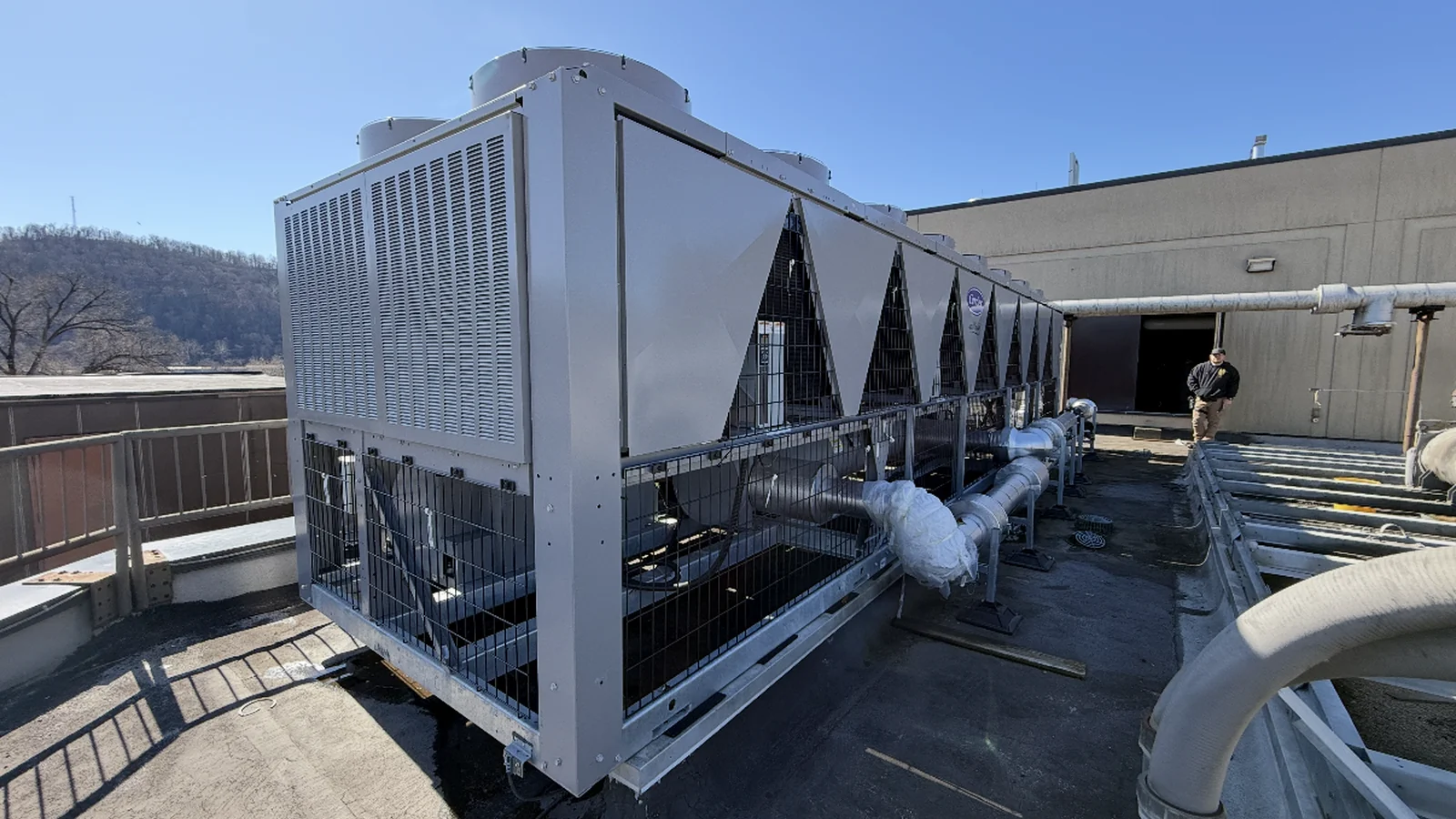
Independent Johnson Controls and YORK equipment identification
Johnson Controls Chiller Identification and Sale Preparation
Have a used Johnson Controls or YORK chiller? Start with the machine’s full nameplate, then connect it to the controller and actual configuration shown on site. Submit the model-to-controls evidence card, condition record, included-equipment boundary, access facts, and release details for independent prospective-buyer evaluation. Submission is not a purchase promise or a service commitment.
YORK model-to-controls review
Send the exact machine record behind the Johnson Controls or YORK nameplate
SurplusChillerBuyer.com is an independent prospective buyer of used and surplus industrial chillers. It is not affiliated with, authorized by, sponsored by, endorsed by, or a representative of Johnson Controls, YORK, or York International. Complete the YORK model-to-controls evidence card with the information you can verify. A readable full model and serial number, controller evidence, photos of the actual configuration, an honest condition note, and real site facts let a direct prospective buyer decide whether further evaluation is warranted. This inquiry does not guarantee a purchase, offer, price, payment, response, inspection, pickup, removal, freight, rigging, dismantling, demolition, refrigerant handling, timing, a local office, crew, or project service.
Useful facts to have ready
- A straight-on, readable photo of every Johnson Controls, YORK, or York International nameplate, with the full model and serial number typed exactly as shown.
- A separate photo of the controller faceplate and any readable controller label, display, or alarm-history screen that can be photographed safely and with site permission.
- Wide photos of the complete chiller, heat-exchanger shells or air-side coils/fans, compressor or motor area where safely visible, electrical enclosure, visible accessories, damage, removed parts, and loose components.
- The model-to-controls evidence card stating the actual brand wording, heat-rejection arrangement, visible control identity, known drive or compressor information, and all included/excluded/retained equipment.
- A present-condition note: operating, idle, disconnected, stored, incomplete, non-operational, or unknown; last known operating date; known alarms, leaks, repairs, retrofits, and missing components.
- Exact U.S. location, installed status, remaining electrical/water/controls/refrigerant connection boundaries, access route, release authority, realistic release window, and site rules.
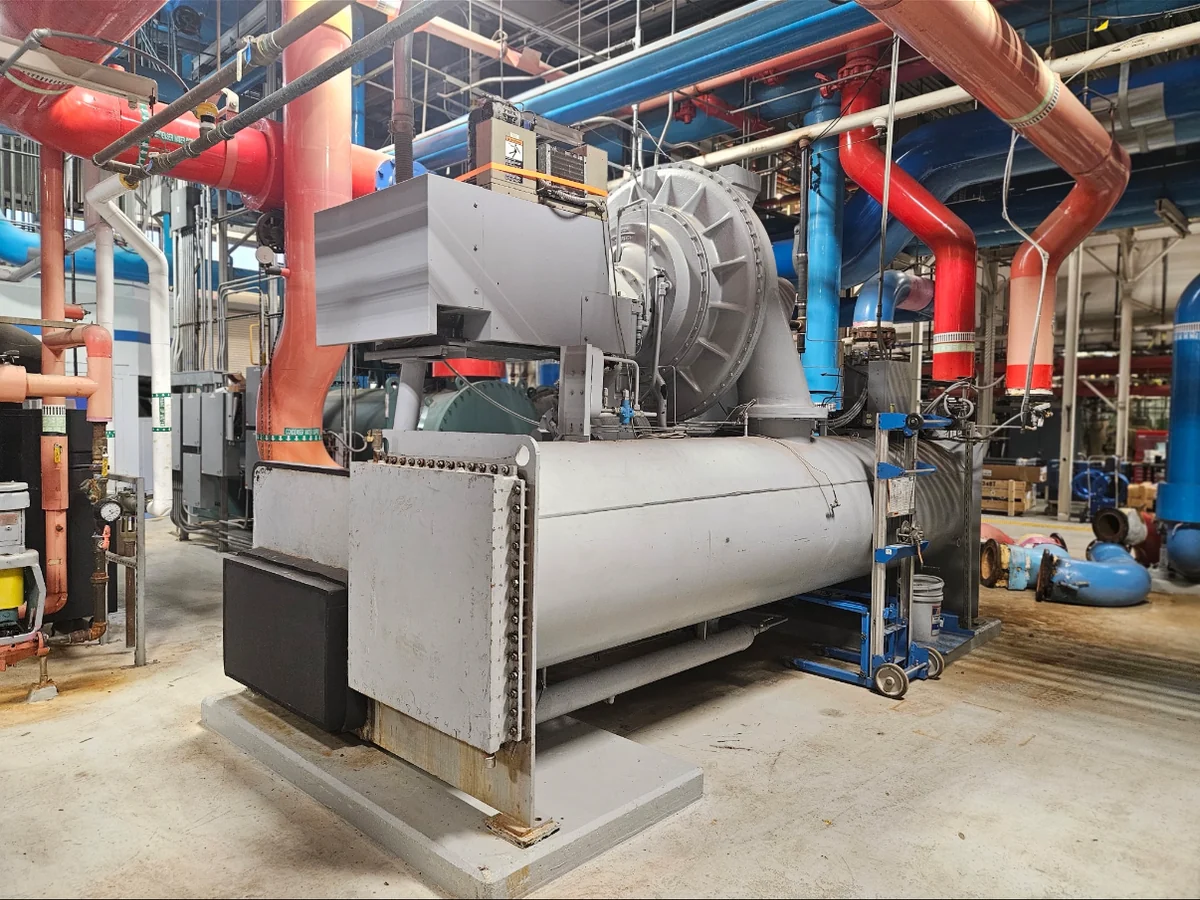
01 / Brand history without guesswork
Use Johnson Controls and YORK to identify the equipment, then verify the exact machine.
Johnson Controls’ current chiller pages present the relevant products under the YORK brand, including water-cooled centrifugal and air-cooled scroll, screw, and magnetic-bearing centrifugal families. Johnson Controls completed its acquisition of York International in December 2005. Use those facts to understand why an offered machine may say YORK or York International in a Johnson Controls inquiry. Do not replace the original nameplate wording with a current model name, and do not call a York International unit a current Johnson Controls/YORK product without matching evidence.
Keep other names out of the relationship. McQuay is a legacy name connected to Daikin Applied history, and AquaSnap is a Carrier product line. Sterling and Temptek are separate manufacturer-identification terms on this site. If any of those names appears in a facility list, photograph the original badge and create a separate equipment record; do not use a plant schedule or a seller’s shorthand to turn it into Johnson Controls/YORK equipment.
- Photograph the full main nameplate, all model suffixes, serial number, voltage, and refrigerant field when safely accessible.
- Record the manufacturer wording exactly: for example, “YORK,” “York International,” or “Johnson Controls”; do not rewrite it from memory.
- Photograph any separate YORK family badge, but keep the full model and serial number as the controlling identifier.
- Give each serial-numbered chiller its own equipment-card number and photo folder in a multi-unit facility.
- If a facility schedule also lists McQuay, AquaSnap, Sterling, or Temptek, preserve it as a source document but match every line to the physical OEM nameplate before describing a brand relationship.
02 / The page-specific evidence card
Connect the nameplate, controller, and physical machine instead of borrowing a current product description.
The current YORK YK page calls out an OptiView Control Center, variable-speed drive, falling-film evaporator, and open-drive motor options. A historical YORK Millennium YT guide uses a Millennium Control Center and says its model number denotes coded characteristics including the cooler, compressor, motor, condenser, power supply, and design level. These are useful examples of why the full code and actual controls matter. They are not a feature checklist for every YORK chiller.
A current catalog can confirm terms only when it matches the full model and apparent configuration. It cannot prove that an older unit has a VSD, falling-film evaporator, open-drive motor, a particular refrigerant, or OptiView controls. Photograph the readable control identity and visible configured components. If the panel is inaccessible, de-energized, password-protected, or unsafe to approach, state that it could not be verified rather than asking anyone to energize equipment or open enclosures for the submission.
03 / Facts today, not brochure specifications
Let the evidence card show what this chiller is now.
Describe present status in plain language: operating, idle, disconnected, stored, incomplete, non-operational, or unknown. Then state the last known operating date separately from the present status. Record known alarms, shutdown history, leaks, repairs, corrosion, damaged insulation, removed parts, modifications, and storage exposure. A controller display, prior work order, or building-automation point list can be useful evidence, but none of them proves present capacity, leak-tightness, completeness, or operating condition.
Record refrigerant only from a legible unit label or records tied to the same chiller. Current YORK product pages list specific refrigerants for particular current models, and the historical YT guide identifies HCFC-123 for that historical model range. Neither source establishes the refrigerant or charge status of a different or modified used unit. If refrigerant circuit work may be necessary, identify it as an open project item and retain applicable records; do not call a chiller “empty,” “recovered,” “charged,” or “leak-free” without support.
04 / Machine boundary, site boundary, work boundary
An identifiable JOHNSON CONTROLS/YORK chiller is not automatically a complete plant or an intact-removal project.
State what transfers with the chiller and what stays with the site. For a water-cooled machine, separately list chilled-water and condenser-water connections, pumps, cooling-tower equipment, valves, headers, controls, starters, panels, supports, and heat-recovery equipment. For an air-cooled machine, separately list field power, water or glycol piping, remote controls, supports, roof curbs, and associated plant components. State which utilities or building systems remain connected. This inventory helps evaluate a potential equipment transaction; it does not assign disconnection, isolation, removal, or any other work to SurplusChillerBuyer.com.
Keep the disposition options distinct. Intact removal means taking the identified chiller as a whole machine after defined connection and site boundaries are addressed. Dismantling or cut-up means a different scope that can lead to disposal. EPA states that chillers typically dismantled on site before disposal must have refrigerant recovered under its Section 608 servicing requirements. Hazmat review, permits, waste handling, structural work, utility isolation, fire watch, and site restoration depend on the actual site, applicable requirements, and responsible qualified parties; they are not automatic buyer services.
05 / Verified facts before a possible handoff
A transaction discussion needs the exact machine, route, lifting evidence, and qualified-party planning—not a generic pickup assumption.
Provide the exact equipment location and real path from the chiller to a possible loading point: floor, roof, yard, basement, mechanical room, elevation, doors, hatches, corridors, turns, stairs, elevator limits, roof-edge conditions, staging area, truck approach, and facility work restrictions. If intact removal might later be discussed, supply verified unit weight and dimensions from a matching label, matching documentation, a scale record, or qualified measurement. Do not use capacity, a similar YK/YT model, or a current product page as a weight or dimension substitute.
Capture manufacturer-labeled lifting points and center-of-gravity or rigging information when available, but do not invent lifting points or a method. OSHA requires material-handling rigging equipment to be inspected before use and requires legible manufacturer identification showing recommended safe working load. The facility and responsible qualified parties must determine the lift method, route, equipment, site controls, inspections, and authority for the actual project. Sharing evidence enables buyer evaluation only; SurplusChillerBuyer.com does not automatically plan, supply, supervise, pay for, or perform rigging, removal, freight, pickup, or a schedule.
Frequently asked questions
Before you send the chiller.
If your machine does not fit a standard category, submit the available details anyway. Clear photographs and a readable nameplate often establish whether more information is worthwhile.
Is SurplusChillerBuyer.com affiliated with Johnson Controls or YORK?
No. SurplusChillerBuyer.com is an independent prospective buyer of used and surplus industrial chillers. It is not affiliated with, authorized by, sponsored by, endorsed by, or a representative of Johnson Controls, YORK, or York International. The names are used only to identify equipment.
Why can a YORK or York International chiller appear on a Johnson Controls page?
Johnson Controls acquired York International in December 2005, and its current chiller pages use the YORK brand. That corporate history supports a Johnson Controls/YORK identification inquiry. It does not make an older York International machine a current model or prove any specification, condition, support status, or value.
What is the YORK model-to-controls evidence card?
It is a seller-created record that links one full nameplate and serial number to the controller identity and visible configured machine. It can include a documented OptiView or Millennium controller, heat-rejection arrangement, driveline evidence, included components, condition facts, and release details. It is not a diagnosis, performance test, or OEM verification.
Can I use a current YK brochure to identify an older YT or another YORK chiller?
No. The current YK page and historical YT guide show different control and configuration references. Use matching literature only after the full model code and physical unit support the match. A current page cannot establish an older unit’s capacity, refrigerant, options, weight, dimensions, condition, or operating status.
Do you handle removal, rigging, refrigerant recovery, demolition, or freight for a Johnson Controls/YORK chiller?
No work is included automatically. Submission does not guarantee a purchase, offer, price, payment, inspection, pickup, removal, freight, rigging, dismantling, demolition, refrigerant handling, timing, local office, or project service. Intact transfer and dismantling/cut-up are different scopes. EPA states that chillers typically dismantled on site before disposal require refrigerant recovery under Section 608 servicing requirements; any possible scope must be evaluated for the actual project and confirmed in writing.
Authoritative references
Source material behind this seller guide.
These external manufacturer and government sources support the equipment terminology and planning context used above. They do not establish the condition, configuration, safety, compliance, or transaction fit of a specific chiller.